Showing posts with label ruins.. Show all posts

Friday, July 7, 2017

BGiME #6: “Defend the Ruins!”

Looking back over the previous entries, I see I never posted the actual play—or as they call it over at Spillforeningen the Fellowship STF, “the post-battle bat-rep breakdown”—of issue #6's Battle Game. There’s been a lot of water under the Brandywine Bridge since we played this, but I have pictures and a faint memory of what went on. This battle sees Aragorn facing off against a group of Uruk-hai who are trying to find a secret entrance into Helm’s Deep. If Aragorn can hold them off for ten rounds, Good automatically wins. If the Uruk-hai find the secret entrance before then, the number of Saruman’s servants who enter the tunnel dictate whether Good or Evil triumphs, or it’s a draw.

We played this one a few times, as it was a short scenario. I recall one battle saw the Uruk-hai gang up on Aragorn and take him down, while another had Aragorn running willie-nillie, cutting down the Uruk-hai before they could locate the entrance. It proved to be a balanced, if not especially long battle game.

The field of battle. Aragorn stands alone against five Uruk-hai!

The Uruk-hai advance and Aragon chooses his first opponent.

An Uruk-hai stalks the ruins, seeking the hidden entrance into Helm's Deep.

Aragorn rushes to stop his enemies from searching the ruins.

Get 'em! Three Uruk-hai face off against Strider.

"You'll not get past me, filth!"
That rounds out coverage of issue #6 of Battle Games in Middle-earth. We’ll pick up with issue #7 in a day or two. Thanks for stopping by!

Friday, June 17, 2016

BGiME #6: Making Ruins

I’ve said it before, but constructing terrain—especially ancient and/or mysterious structures from the distant past—is one of my favorite aspects of the miniature wargaming hobby. As such, issue #6’s terrain-making chapter is my favorite one so far. The process of making more advanced ruins is presented in this issue. The techniques are simple and the results are terrific.

The “Defend the Ruins!” scenario found in this issue requires six pieces of terrain. Although any of the terrain from previous “Modelling Workshop” chapters would serve, I wanted to conjure up images of the early centuries of the Third Age and perhaps lingering relics from the Second Age of Middle-Earth in my games. So an even half-dozen ruins it must be!

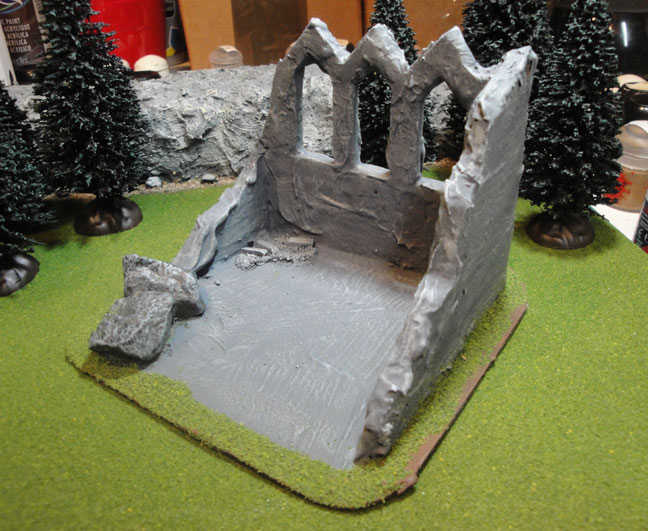
The ruins are made largely with thick cardboard cut into the appropriate shapes with a craft knife, then mounted on base of thin card. Spackle is applied to give the pieces texture and, once dry, each ruin is then painted and flocked. I did these six in about a week of intermittent work, but could have easily cranked them out in a weekend if I had need to.

These are the ruins in the early stages of construction. Masking tape is applied to the cardboard edges to conceal the corrugation and create the appearance of solid stone. Each entire piece is next slathered in spackling compound. I went a little heavy in places, resulting in “frosted cake” consistency that is a bit too thick, but they still look fine for the tabletop. I finally sprinkled “sprue rubble” and a few rocks I picked up while walking to add some more details to each piece.


Once the spackling compound dried, I applied a basecoat of black spray paint for coverage.


Each of the ruins was drybrushed with a dark gray paint, followed by another drybrushing of a lighter gray, then one last layer of drybrushed off-white to pick out the final highlights. The borders of each ruin was painted a chocolate brown and a layer of grass flock was applied to finish off the ruins.


Overall, I’m tremendously satisfied with the results. The cost was negligible, making them was quick, and the technique to craft them was simple. I can easily see myself using the same method to make more elaborate ruins for a city-centric miniatures wargame. With a little snow effect flocking, similar ruins would make a great addition to a Frostgrave gaming table. Next up, we’ll see how they look on the tabletop when we play through “Defend the Ruins!”

Battle Games in Middle-Earth #6 Overview

The spring has turned into summer since I last posted words here and we’ve said farewell to the rain and cold that stymies our efforts to prime and seal the painted warriors of Middle-Earth. Despite the lack of scribed words and posted reports, there’s in truth more SBG gaming happening around these parts than ever before. My efforts to beat the bushes for people interested in the SBG has borne fruit and my Facebook feed is richer than ever with Middle-Earth miniature news, thanks to my discovery of the GBHL. So, in celebration of this increased gaming activity, let’s continue our examination of Battle Games in Middle-Earth.

Battle Games in Middle-Earth #6 greets us with the stoic visage of Aragon staring at us giant-like from beyond the ramparts of Helm’s Deep. Right away, we know we’re in for some Strider-centric action this issue. The enclosed miniature model, selected from the “Heroes of Helm’s Deep” boxed set and depicting Aragorn rushing into battle clad in his chainmail hauberk, confirms our suspicions.

As always, the issue begins with the “Guide to Middle-Earth” section. Issue #6 is focused on Aragorn, Hero of Helm’s Deep. It recounts his journey from a Ranger in the wild to the fateful council in Rivendell to his efforts to defend the Ringbearer and rescue Merry and Pippin from the clutches of Saruman’s Uruk-hai. The article ends by setting us up for the rest of the issue, discussing Aragorn’s apparent death and subsequent arrival at Helm’s Deep at the cusp of the Battle for the Hornburg.

“Playing the Game” offers up a new wrinkle in the movement rules: climbing, jumping, and falling. Having mastered the basics of movement and the role terrain plays on model movement in the game in previous issues, BGiME #6 provides rules for moving miniatures up, down, over, and across terrain, obstacles, and barriers. It describes the differences between barriers and difficult terrain, presents rules and charts for determining a model’s success in scaling or leaping across obstacles, and the consequences of falling from heights. Thanks to these new rules, tabletop battles are no longer limited to two dimensions. The section closes with notes on how barriers affect trapped models in the Fight phase and gives the reader rules for concealing warriors by laying them prone behind terrain and how to determine if the enemy spots them.

The “Battle Game” chapter includes a new and interesting scenario, “Defend the Ruin!” This scenario depicts a classic “what if?” situation: Could Aragorn stop a band of brutal Uruk-hai intent on sneaking into the Glittering Caves and massacring the women and children of Rohan? Not only is this a challenging scenario for the players, it also features the first time limit on a game we’ve so far seen in BGiME. The Evil player has just ten rounds to find the secret entrance to the Glittering Caves and get his Uruk-hai inside before Rohan reinforcements come to Aragorn’s aid. Given that neither Good nor Evil player knows the location of the secret entrance at the start of the game, and that Aragorn must stop or slow down five brutal orcs to achieve victory, this scenario isn’t easy for either side to score a decisive victory. In typical fashion, we’ll look at “Defend the Ruins!” in more depth in a later post.

“Painting Workshop” describes techniques and offers useful tips for painting our new Aragorn model. Much of the information is material we’ve seen before, but the concept of customizing miniature bases is introduced with a “top tip” instructing the reader to adorn Aragorn’s base with a small stone painted in appropriate gray tones. Anyone who has done excessive base modeling for their figures knows that this is the first small step towards a gentle madness!

Issue #6 ends with the “Modelling Workshop” section and it’s an excellent one. This chapter is filled with detailed instructions on constructing ruins of far better quality and appearance than the simple one from issue #2. Using basic, inexpensive materials such as thick cardboard and Spackle, the reader can craft impressive-looking, yet crumbling relics from a previous time in Middle-Earth. These ruins make fantastic terrain, barriers to be breached or defended, or objectives to be taken or held. I was personally inspired to make six ruins for my table after reading this chapter and they all look fantastic.

The issue closes with the usual sneak peek at the next magazine’s contents. We see that we have a sprue of Rohan Warriors headed our way in issue #7, as well as new rules for defending barriers, tips on building walls and fences, and a scenario pitting Rohan against rampaging Uruk-hai. Sounds like a great issue! We’ll cover it in the weeks ahead. Until then, let’s take a further look at the fun stuff in Battle Games in Middle-Earth #6.

Monday, July 13, 2015

BGiME #2: Creating a Simple Ruin

I have a love affair with making smaller versions of big things that goes back to the first time I ever saw a museum diorama. I’m utterly fascinated by the skill and labor it takes to reproduce the real world in a smaller scale and just seeing a well-crafted scenic diorama or tabletop battlefield or model railroad layout always immediately transforms me into a joyful child. It’s no wonder that my favorite section of Battle Games in Middle-Earth is the “Modelling Workshop” chapter of the magazine.

Issue #2 contains instructions for creating an extremely simple ruin for your battlefield, a piece crafted from thin and thick card and a craft knife. It’s the sort of project that takes less an hour if you don’t count the time it takes for the glue to dry. Simply bisect a square of thick card with a jagged, ruined wall-type cut, glue the two section together back to back, and stick it to a square of thin card. A coat of green and gray paint later and you’ve got yourself your first piece of scratch-built wargame terrain.

Defend this crumbling corner of Arnor!
The base of thin card warped when painted.


Nothing fancy, but it works.

The simple ruin provides cover for a squad of Grey Company Dunedain.

Let’s face it: this is a beginner project and doesn’t have much shelf-life as a piece of terrain. Even the project in issue #3 is more advanced and better looking than this one and the ruin is going to be swiftly replaced by more impressive scenery. Does that make crafting this simple ruin a waste of time? Not completely. 

First, for the neonate wargamer, it gets them scratch-building early and thinking about better projects they might want to tackle. Secondly, it serves fine in a pinch to add a little more variation to the battlefield or to act as an objective point. Thirdly, this is prime hand-me-down terrain. If you have children hanging around you regularly, you know they tend to become interested in whatever Dad, Mom, Uncle John, Cousin Bill, etc. is doing and might want to start playing with little soldiers themselves—even if they don’t use dice, tape measures, or other things like rules. This piece, quick and cheaply made, it something you wouldn’t mind letting them use when they play or as a project you could create with them as a lazy Sunday afternoon activity. I’ll keep my simple ruin on my shelf for now and I might put it to use a few issues from now when we play through the “Defend the Ruins!” scenario found in issue #6.